
Kimball Shahrokhi
A Technical and Strategic Guide for Facility Owners and Decision-Makers
Introduction
Most pharmaceutical and biotechnology manufacturing facilities require one or more process waste treatment systems. These systems span a wide spectrum, from pH neutralization to biowaste inactivation to specialized chemical treatment, and the appropriate solution is never a one-size-fits-all. The requirements of each facility must be carefully evaluated so a system can be engineered to fit the desired performance criteria, available footprint, utility infrastructure, and capital budget.
Process waste systems are not optional infrastructure; they are a critical element of regulatory compliance, operational continuity, and risk management. An improperly designed or undersized system can trigger EPA or local sewer authority violations, delay facility start-up, and create costly retrofits that far exceed the original planned investment. Getting the right system specified early and partnering with designers and construction partners who understand the nuances of pharmaceutical and biotech waste streams protects your timeline, your license to operate, and your bottom line.
Decisions about waste systems that are made early in a project are far less expensive to get right than corrections made during construction or after startup. The following provides both a technical overview of each system type and a candid discussion of the business implications that owners and project sponsors should consider throughout the design process.
pH Neutralization
Technical Overview
The most common waste system in pharmaceutical and biotechnology manufacturing facilities is pH neutralization. Systems range from batch to continuous flow configurations. Both approaches can achieve regulatory compliance, but the right selection depends on your facility’s operational profile, space constraints, and long-term scalability needs.
Batch Treatment Systems
A batch treatment system consists of at least two treatment tanks, a pump/control skid, and acid/caustic supply drums or totes. Waste flows into an available batch tank until full, then diverts to the second tank. The full tank is recirculated, while acid or caustic is dosed until pH reaches the permissible discharge range of 6.0 to 9.0. Treated wastewater is then routed to the facility’s sanitary system or directly to the municipal sewer.
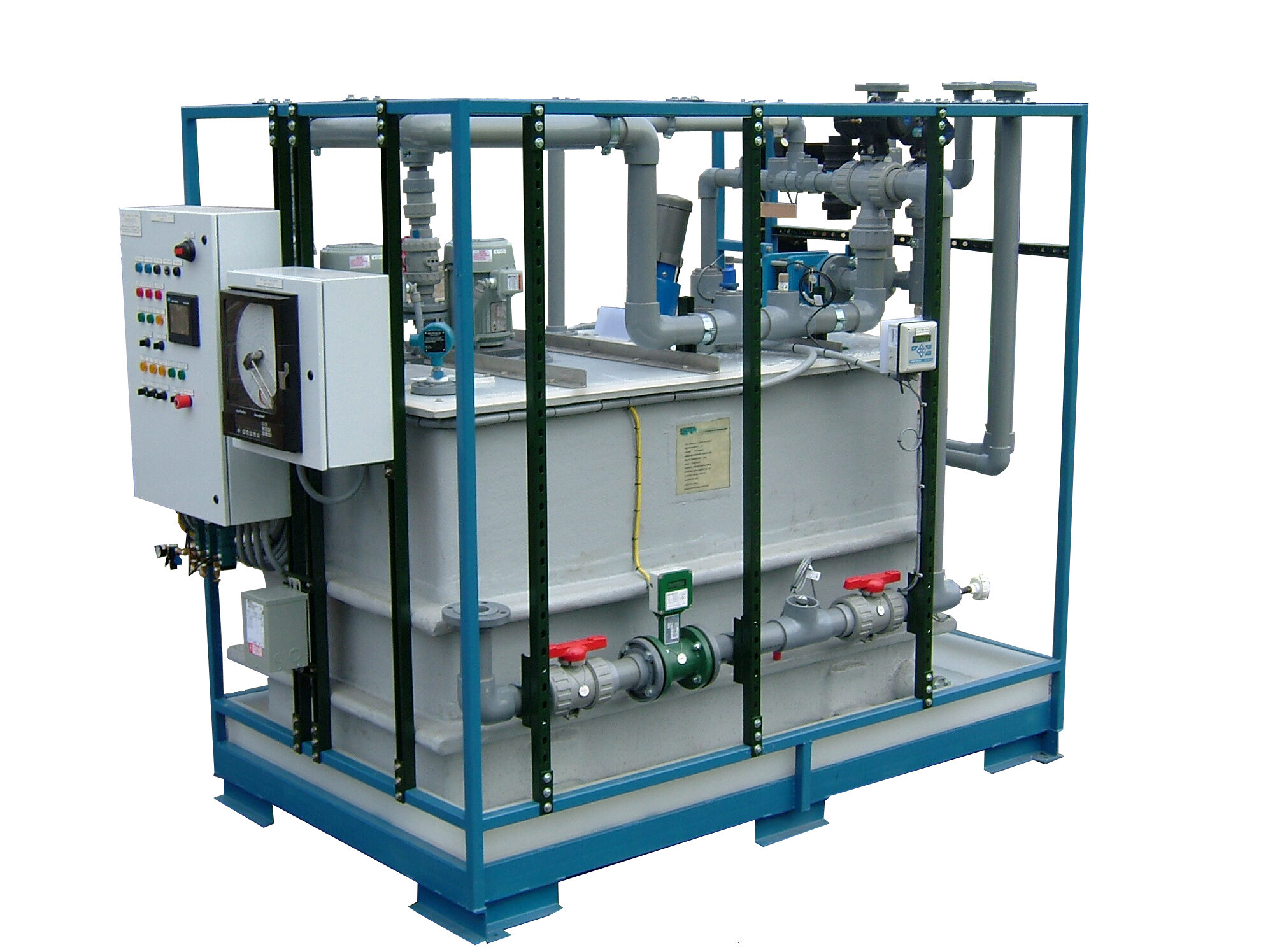
Image Courtesy of Digital Analysis
Continuous Flow Treatment Systems
A continuous treatment system can be as compact as a single tank with internal dividing walls for equalization and neutralization, or as sophisticated as a full neutralization skid with a separate equalization tank, pump/heat exchanger skid, and integrated controls.
In a continuous flow system, waste enters an equalization tank to allow some amount of self-neutralization to occur and to avoid pH spikes caused by process events, such as Clean-in-Place (CIP) cycles. Waste is pumped from the equalization tank through a heat exchanger (if cooling is required) to the pH neutralization skid. The skid uses a recirculation pump and effluent control valve to continuously monitor and adjust pH before discharge. If the effluent pH approaches a limit, the effluent valve closes, and the skid corrects the stream before resuming normal flow.

Image Courtesy of Digital Analysis
Key Owner Considerations
pH neutralization is the foundational waste system for virtually every pharma and biotech facility. Undersizing this system or selecting a batch approach when operations demand continuous throughput can create a bottleneck that affects every production shift.
Key questions to resolve early in your project:
- What are your peak and sustained process drain flow rates, and are there any special characteristics of the anticipated waste flows?
- Does your local Authority Having Jurisdiction (AHJ) require pre-treatment permits, and what are the discharge pH limits?
- Does your facility’s operational model and space constraints favor continuous or batch treatment?
- Is a future expansion of your manufacturing scale anticipated and has the system been sized to accommodate it?
Biowaste Inactivation
Technical Overview
Biotechnology facilities that work with biological agents often require biowaste inactivation prior to discharge, either to the sanitary sewer or, more typically, to the facility’s pH neutralization system. Inactivation can be achieved through heat treatment or chemical methods in both batch and continuous flow configurations.
Effective system design begins with thorough waste stream characterization: the type(s) of pathogen or biological hazard present, the volume and physical nature of solids in the stream, and the temperature / pH profile of the waste. This characterization directly determines the inactivation method, required residence or retention time and temperature, tank sizing, and system redundancy requirements.
Heat inactivation is the most broadly applicable method. It addresses a wide range of contaminants and performs reliably even when solids are present in the waste stream. With this method, the system holds waste at an elevated temperature for a validated duration sufficient to ensure pathogen inactivation throughout the stream, including those within any solids matrix.
Typical system components include storage tanks, circulation


pumps, a heat exchanger or direct steam injection system, an effluent cooling heat exchanger, and associated instrumentation and controls. Steam is the most common heat source, though electrical heating is viable for smaller systems. Effluent is cooled before being routed to downstream pH neutralization.
A formal risk assessment is essential for these systems to define requirements for equipment redundancy, backup utilities, redundant instrumentation, and provisions for segment inactivation and CIP to safely support maintenance activities. PPE requirements and local exhaust ventilation for maintenance personnel must also be addressed.
Key Owner Considerations
Biowaste inactivation systems sit at the intersection of regulatory compliance, biosafety, and operational uptime. Regulatory bodies, including the FDA and local health authorities, scrutinize these systems carefully. A system that lacks adequate redundancy, is improperly validated, or lacks provisions for safe maintenance can result in a facility shutdown, consent decrees, or biosafety incidents.
Critical owner considerations:
- Biowaste systems require a validated inactivation process. Design must support future validation protocols from the outset.
- System design should be based on risk analysis (including the necessary levels of system and component redundancy).
- Provisions required for maintenance access and personnel safety must be considered, especially for frequently accessed instrumentation, but also for less frequently accessed equipment in the event of a breakdown.
- Early engagement with your design partner on waste stream characterization prevents costly design revisions as the project advances.
Chemical Treatment
Technical Overview
Some process waste streams require treatment beyond pH neutralization or biowaste inactivation. Specialized chemical treatment systems are designed to address facility-specific contaminants and may include activated carbon filtration, chemical injection for particle removal, oxidation processes, or other advanced effluent treatment technologies.
Like other process waste systems, chemical treatment configurations typically include storage tanks, filtration skids, circulation pump skids, chemical injection and treatment skids, and integrated controls. System design and sizing are developed collaboratively with the client’s process engineers and specialized vendors based on detailed influent characterization.
Key Owner Considerations
Chemical treatment systems are often triggered by the specific chemistry used in your process: solvents, catalysts, APIs, or other agents that cannot be addressed by pH adjustment alone. Early identification of the need for chemical treatment allows it to be integrated into the master utility design. Early waste stream profiling is not just good engineering practice; it is an investment that protects your project schedule.
Key questions for owners to ask:
- Has your process chemistry been fully characterized, including all cleaning agents, solvents, and API residues?
- Have you engaged with your local AHJ early to understand discharge limits that may require advanced treatment or continuous monitoring?
- Is your chemical treatment system designed with future process changes in mind, or is it narrowly configured for today’s process?
Storage & Offsite Disposal
Technical Overview
For certain waste streams, on-site treatment is not the most practical or economical solution. When capital costs, facility footprint, available utilities, or the nature of the waste make on-site treatment impractical, storage and scheduled offsite disposal is the appropriate strategy.
Common candidates include solvent and chemical wastes, as well as waste streams from processes involving potent or highly potent active pharmaceutical ingredients. Small-scale systems typically consist of a collection piping network routing waste to drums or totes within a secondary containment system. Larger systems may include dedicated storage tanks, transfer pumps, and a truck loading station.
Off-site disposal provisions are also routinely incorporated as backup capacity for on-site treatment systems, providing a disposal method when a treatment system is taken offline for maintenance, waste volumes unexpectedly exceed treatment capacity, or a waste stream’s characteristics fall outside the treatment system’s design envelope.
Key Owner Considerations
As with onsite waste treatment systems, off-site disposal requirements should be evaluated early in project planning. Contracted disposal services produce recurring operating costs but offer low capital costs with simple operational requirements.
Questions for owners to consider:
- Have you determined the peak and average process waste flows, the balance of onsite storage, and the disposal frequency?
- Have off-site disposal costs been included in the facility’s long-range operating budget?
- Does your waste storage design comply with EPA and local hazardous waste storage regulations, including secondary containment and labeling requirements?
- Have you established contractual disposal relationships with qualified vendors, including contingency capacity to handle operational surges?
Conclusion
Nearly every pharmaceutical and biotechnology manufacturing facility requires at least one process waste system. Most require a coordinated combination of systems working together. From pH neutralization to biowaste inactivation to specialized chemical treatment to offsite disposal logistics, these systems must be properly characterized, designed, and integrated into the broader facility utility infrastructure from the earliest stages of project development.
The cost of getting these decisions right early is a fraction of the cost of correcting for a failure to properly plan later. A pH neutralization system that is undersized for peak CIP loads, a biowaste system without proper redundancy, or a chemical treatment system that was never sized for the actual effluent profile are the kinds of problems that can surface at the worst possible times: during commissioning, during regulatory inspections, or during a critical production campaign.
At BE&K Building Group, our team brings deep expertise in pharmaceutical and biotechnology facility design and construction, with a track record of delivering process waste systems that are compliant, scalable, and built to support long-term operations. We work collaboratively with your process engineers and project team from early programming through construction, and on to commissioning, qualification, and validation. We ensure that your waste systems are never an afterthought but are fully integrated into your new facility, designed and built to perform.
We invite you to connect with us at the upcoming INTERPHEX show to discuss your facility’s specific waste system challenges. Whether you are planning a new greenfield facility, expanding an existing site, or working through a compliance issue, our engineers are ready to help you find the right solution.